Thursday, February 11, 2010
What makes people follow a 10 year old kid talking about god and creation?
Most of the people follow everything that has a relationship with faith or God. But, what makes them follow a 10 year old kid talking about god and creation? I think because they find the kid cute, screaming all over the place, talking about God. At start, they think its a joke, but later on, they pay attention to what the kid says, and start to believe on him (remembering how was the first time.. the first impression is never erased). Most of traditional christians think religion is a big deal, and they take everything personal, even this kid; so when they hear someone talking about this kid, there will be 2 reactions:
1. Oh yeah, that kid is so right. Everybody should be like him (Hipocresy in another words)
2. Hey! stop talking like that about the kid! He is right, and don't mess with his mother! (Complete ignorance of the big picture)
Also, maybe people believe this kid because of the trust and emotion it inspirates on others (he could be talking about how he peed in his bed last night, and people would still take it seriously), his phrasing (which I think he made up while remembering one of his traumas as a strange boy), and because of the fact of being a boy with a suit that doesn't fit him. A clear way to prove that is watching his actual videos, and see that he doesn't have that charm he had as a boy...
Maybe every kid should go on stages, talk about things you dont understand, wear a big tuxedo, give interviews, sing, etc. and make money from it, because why talk about something you don't even understand completely with people clapping and (blindly) loving you if you can't make a profit of it... Which bring us back to the same question: Why? make your own conclusions...

Monday, February 1, 2010
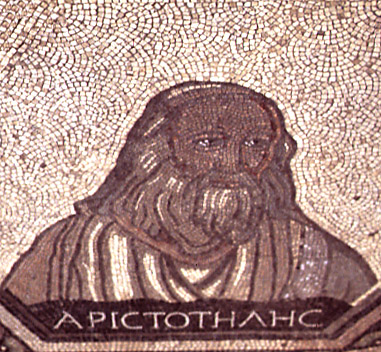
Aristotle

Aristotle (in greek Ἀριστοτέλης, born in 384 BC, died 322 BC) was a Greek philosopher and a disciple of Plato. His thought differs from Plato's in a lot of things, like in metaphysics, political theory, and in psychology (the theory of the soul), speacially in the theory of the soul. Aristotle's base of psychology is this theory, and he bases his theory on natural science (I still don't know what he means with natural science), saying that the soul is the thing that owns the psychic functions (memory, breathing, nutrition, growing, emotions, perception, and thought), and the body is the thing in which these functions are embodied and receptors from other people. Also the soul is able to survive after the body is dead, keeping all its characteristics (but where does it go? no explanation there), totally independent of the body (so it can take over a body. Where? In the body factory before its delivery?) and immaterial.
In ethics, Aristotle talks about eudaimonia, moral virtues, virtues of intellect, the "mean", and how all this cant be achieved, only some of this or parts of all of them (maybe because that would be perfection itself... hmmm...)
I can specify all about Aristotle, but its late (22:00), I dont remember much of it because it was something we saw 2 weeks ago (short memory =P) and it must be done so Jose can check it and stablish my grades.

Is the soul a product of body functions?

For Aristotle, its the other way around (body functions are the product of the soul), and for me too. Only some body functions which end up to be fake or to be empty don't come from the soul, because soul is passion, and if there is no passion on what you do, then that body function comes from nowhere.
The soul is something immaterial, independent of the body and capable of surviving its death, according to Aristotle. I initially thought that the soul for Aristotle was the passion of a human being, the motor that keeps dreams alive, but I now see its something else.
For Aristotle, the soul can't work without a body, and also the other way around (well, it can work, but it would be the same as someone in a coma), because the soul has the functions of memory, breathing (well, the breathing is controlled by the brain, not the soul), nutrition, growth and emotions, and the body was only the thing that would interpret these functions and receive them from other people. In another words, Aristotle is saying that the brain is independent from from the body itself, but can't blame him for that. Technology wasn't so advanced, and they thought women are not people.
Subscribe to:
Comments (Atom)